Little Gems: The Economics of Being Unexpectedly Delighted
Does it matter if nobody sees something you've created? Of course it does, to a degree. We generally make things because we hope someone will enjoy them, learn from them or find them useful. But what if the cost of creating that thing approaches zero? What if the economic consequences of nobody noticing it begin approaching zero as well?
That might sound like a small change in the economics of content. I suspect it's an enormous one.
For most of history, you needed a reasonable audience to justify the work. Writing, illustrating, filming, editing and distributing something cost time and money. If nobody turned up, you had a rather expensive problem.
Now imagine being able to create a fascinating, beautifully presented little piece of content for one person in one particular place at one particular moment. If they enjoy it, wonderful. If they never see it, perhaps very little has been lost.
*For the first time, we might be able to create things simply because somebody might appreciate them.*
Little gems, scattered throughout the day
I don't mean more videos shouting for our attention. I mean little gems: a delightful fact, a beautiful photograph, a tiny lesson, a clever trick, a story worth sharing, or something that makes you smile.
You walk into a café and encounter an obscure but wonderful story about the neighborhood. Twenty minutes later you tell your friend over lunch. An interesting fact about an everyday object becomes an icebreaker later that evening. A woodworking tip appears near your workshop bench at precisely the moment it becomes useful.
None of these experiences demanded that you open an app, search for an answer or commit to consuming content. They were just there, waiting for the possibility of appreciation.
Some might be encountered by a thousand people. Some by one. Many by nobody at all. That's okay, provided the content is trustworthy, appropriately chosen, inexpensive to create and respectful of the space it inhabits.
Not valuable enough to demand your attention. Just valuable enough to reward it.
The extraordinary economics of being ignored
If making a little gem costs a hundred pounds, it probably needs an audience. If it costs a fraction of a penny, the calculation changes. You might create a thousand highly specialized pieces of content knowing that only a handful will ever be discovered.
Of course, generation isn't literally free. Verification, factual accuracy, licensing, storage, energy, distribution and editorial quality still have costs. But as the marginal cost falls, the minimum viable audience can shrink dramatically.
The change isn't that nobody needs to look. It's that content no longer has to be confident of finding an audience before it becomes worth creating.
This makes room for content so specific that no traditional publisher would have bothered producing it. A single place. A single interest. A single quiet moment.
A finite visual world we barely think about
Here's another thought experiment. Almost all of us move through the day with a finite field of vision. We have 24 hours in a day and, to use a rough illustrative assumption, around 16 waking hours—57,600 seconds in which our surroundings are available to be seen.
What fraction of that ever-changing visual environment could potentially contain something interesting, beautiful or useful? A tiny screen here, a digital frame there, a display on a café counter, something subtle in a hotel lobby or restaurant.
I sometimes imagine the visual field as a kind of viewport: not literally a fixed number of megapixels—human vision is much more complex than a camera sensor—but a finite canvas in which objects occupy apparent size and time.
That gives us an intriguing way to compare a large billboard with a small, nearby display.
A billboard the size of a house, and a screen the size of a book
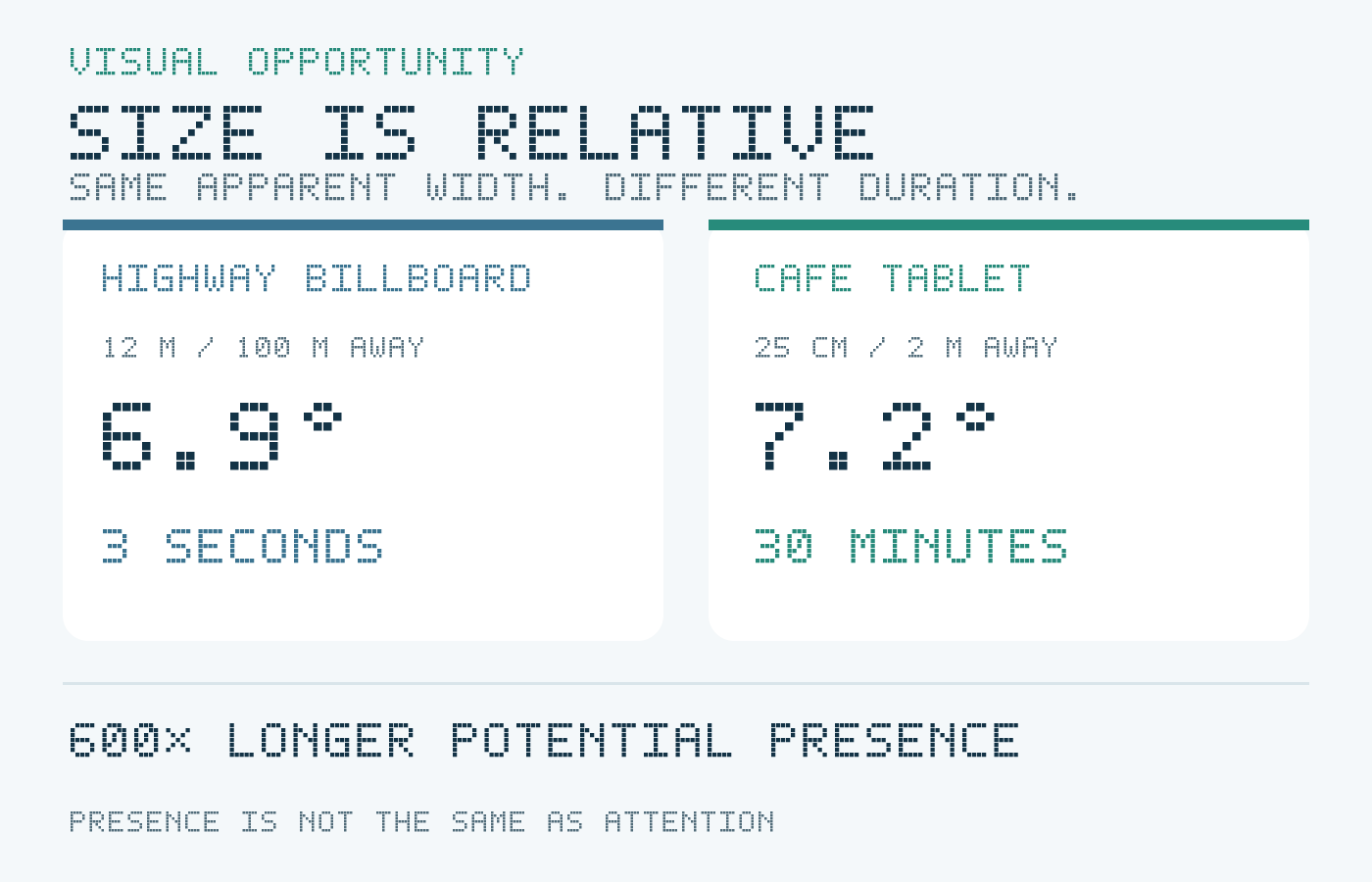
A highway billboard is enormous partly because it needs to be legible from far away. Its apparent size from the driver's perspective can be surprisingly modest. A tablet nearby can subtend virtually the same angle despite being dozens of times smaller physically.
Here's an illustrative comparison. A 12-metre-wide billboard viewed from 100 metres away occupies about 6.9 degrees of horizontal visual angle. A 25-centimetre-wide screen viewed from two metres away occupies about 7.2 degrees. Those are calculated geometric angles, not measured engagement.
At 120 km/h, a vehicle moves about 33 metres per second. A fleeting roadside encounter may last only a few seconds. A much smaller display in a café could remain somewhere in a visitor's visual environment for half an hour.
Using three seconds and 30 minutes, that's a 600-fold difference in potential duration, even though the angular widths are similar. It's emphatically not 600 times more attention, or 600 times more advertising value. People look at friends, menus, food and phones. Something merely sitting in peripheral vision is not necessarily being read.
But the disparity is enough to make the question interesting: why have we invested so heavily in fleeting visual impressions while paying comparatively little attention to the places where people naturally spend time?
There are already digital-signage, restaurant-display and out-of-home advertising businesses. The opportunity isn't that nobody has ever placed a screen in a café. It's that a vast network of inexpensive, context-aware displays offering delightful, generative content is still far from an everyday default.
Viewport-seconds: measuring an opportunity, not a captive audience
Suppose we wanted a way to describe this. We might call it visual opportunity: apparent share of a person's view multiplied by the amount of time a display is available to be seen.
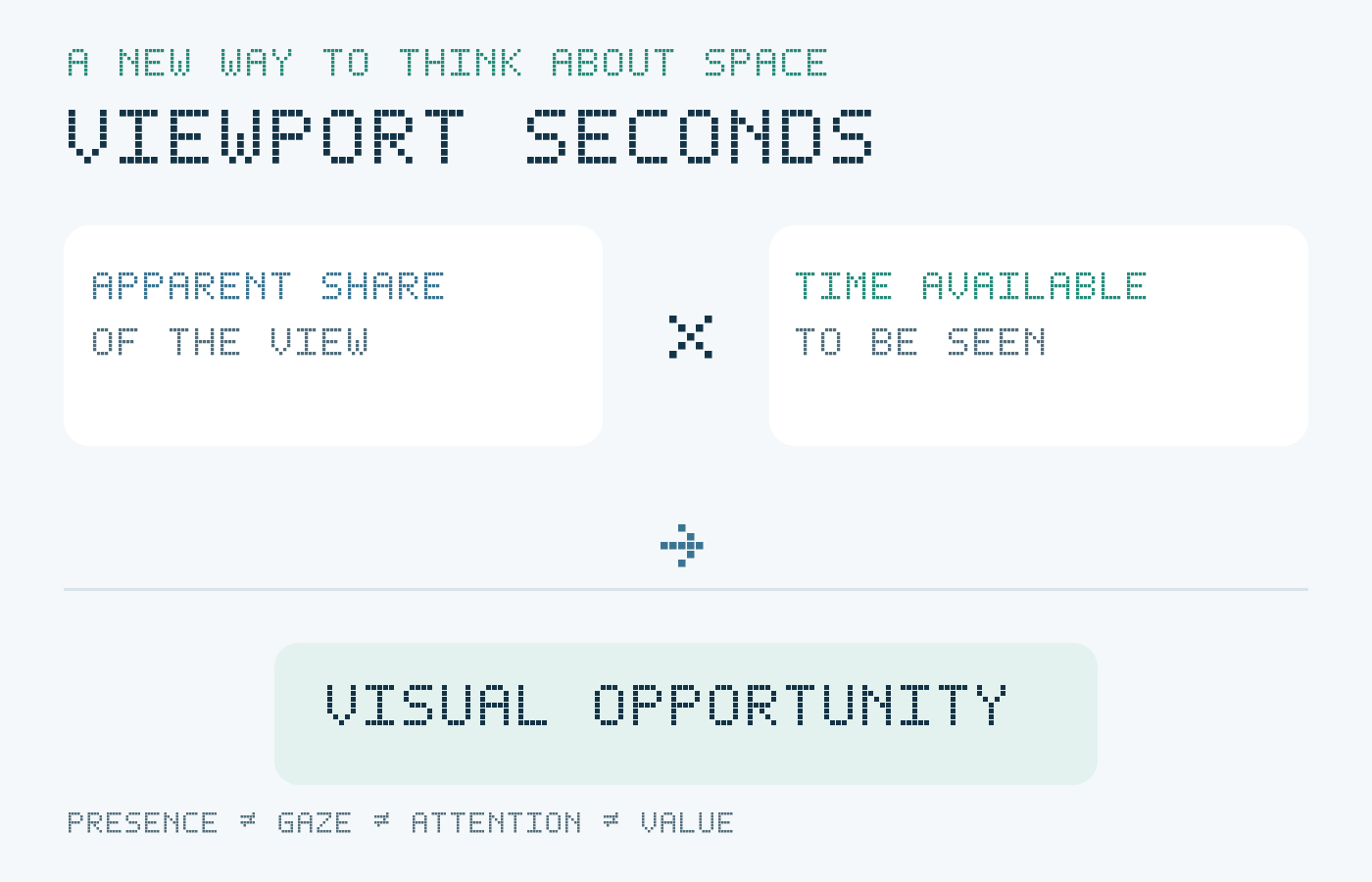
There's no claim here that 'viewport-seconds' is an established currency for advertising. Nor that it automatically correlates with GDP. To turn it into something economically meaningful, we'd need real observations of viewing conditions, reach, readability, content quality, repeated encounters and actual outcomes.
And perhaps the metric should never be reduced to advertising value alone. A person could glance at an obscure scientific fact, remember it and share it the following week. The platform might never record that as an engagement event, even though the moment was genuinely worthwhile.
A market for moments rather than audiences
Social media largely organizes content around audiences and feeds. We open a destination and an algorithm tries to keep us there. Generating more content usually means asking someone to give up more attention.
Ambient content suggests the reverse. The environment already contains natural moments when we glance around: waiting for a coffee, pausing between tasks, sitting in a reception area, walking into a kitchen.
Instead of dragging people towards more content, what if we quietly placed the right little gem in one of those moments? Sometimes the right content is a photograph. Sometimes it's a genuinely useful piece of learning. Sometimes it's a fact you can recycle at dinner and sound suspiciously well-informed.
And sometimes the most intelligent choice is to show absolutely nothing.
I like the idea of a screen that doesn't measure success by how long it can hold your gaze. A smile, a useful recollection or a conversation started later might be a better outcome than another fifteen minutes of scrolling.
What does a business actually sell?
I doubt the strongest business would sell individual facts or poems by the piece. The real value could be the infrastructure for making moments possible: inexpensive screens, context, content generation, trustworthy selection, timing, permissions and a network through which publishers, artists, venues and brands can participate.
A café might want a subtly different experience from a library, restaurant or workshop. A hotel could introduce local artists. A business could deliver tiny lessons to relevant parts of its workplace. A household could turn an old tablet into a calm, occasionally delightful window onto the wider world.
Commercial messages might have a place, too, but only when they genuinely belong and when the venue and viewer are comfortable with them. Turn every surface into an obnoxious advertising screen and the whole concept loses its charm.
There is also a particularly attractive hardware angle: many phones and tablets are discarded long before their displays become useless. Repurposing them as purpose-built ambient surfaces could make deployment far cheaper than installing dedicated digital signage everywhere.
The abundance of content should give us the luxury of restraint
There's an obvious trap in all this. If making content becomes cheap, we could end up filling every spare pixel of the world with noise.
That would be the worst possible interpretation. The purpose isn't to monetize every second of human eyesight. It's to create a world in which a tiny fraction of ordinary moments become unexpectedly richer.
Quality still matters. Accuracy matters. Respect for attention matters. Context matters. And the fact that nobody might ever see something is no excuse for carelessly generating misinformation or clutter.
What changes is our willingness to make something thoughtful for a very small possibility of appreciation.
A world full of little gems
We have spent decades engineering media to bring people to content. Maybe the next opportunity lies in bringing little pieces of content to places and moments where people might appreciate them, without asking those people to go looking.
A forgotten tablet in a café. A tiny display beside a workshop bench. A frame in the hallway. A moment that produces a smile, a useful idea or an unexpectedly excellent dinner-party fact.
Some of those gems will be seen. Many won't.
But if the cost of making them continues to approach zero, perhaps that no longer needs to be a tragedy.
Maybe the future of content isn't an endless stream demanding to be watched. Maybe it's a world filled with little gems, quietly waiting to be discovered.